

HS codes are 6-digit internationally standardized product classification codes used by customs in 200+ countries to calculate import duties. US importers use 10-digit HTS codes — a US-specific extension of the HS system. Every ecommerce seller shipping internationally must assign the correct HS or HTS code to each product, or risk customs delays, duty reassessments, and fines.
For ecommerce sellers shipping internationally, HS and HTS codes are not optional — they are a critical part of customs compliance, duty calculation, and smooth cross-border delivery. Incorrect classification can lead to delays, unexpected costs, fines, and even shipment seizures.
This guide explains what HS and HTS codes are, why they matter, and how ecommerce sellers and logistics warehouses can manage them correctly in 2025 and beyond.
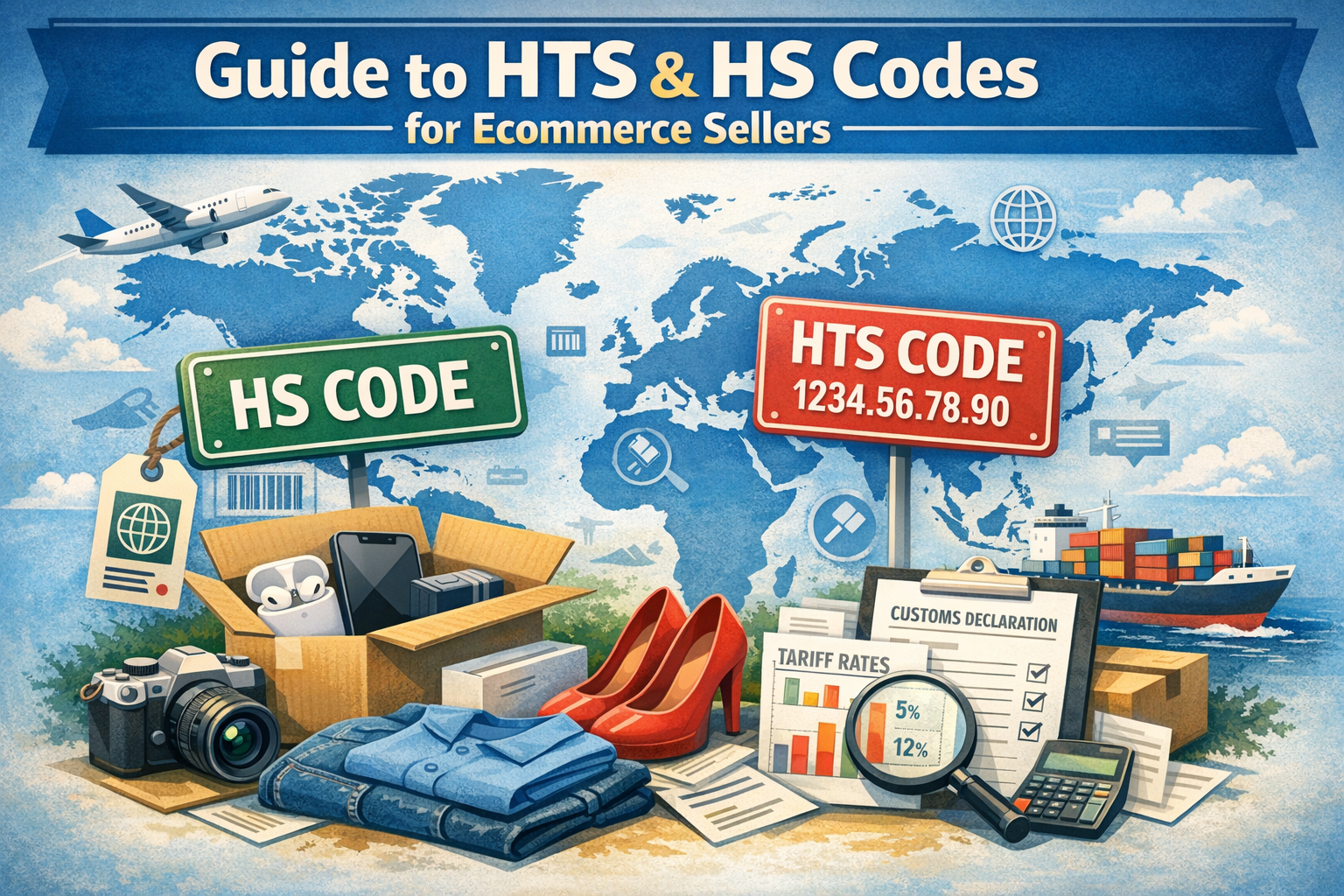
What Are HS Codes?
HS (Harmonized System) codes are internationally standardized product classification codes used by customs authorities worldwide. They were created by the World Customs Organization and are used by more than 200 countries to identify goods for customs purposes.
An HS code consists of 6 digits:
- First 2 digits – product chapter (broad category)
- Next 2 digits – product heading (subcategory)
- Last 2 digits – sub-heading (specific product type)
These six digits form the global foundation for product classification in international trade.
According to the World Customs Organization, the Harmonized System covers more than 5,000 commodity groups, organized into 21 sections and 99 chapters. It is updated approximately every 5–6 years to account for technological change and new product categories — ecommerce sellers should verify their codes against the current version to ensure accuracy.
What Are HTS Codes in the United States?
The United States uses an extended version of the HS system called the Harmonized Tariff Schedule (HTS). HTS codes contain 10 digits:
- The first 6 digits match the global HS code
- The final 4 digits are U.S.-specific and determine duty rates and regulations
U.S. Customs and Border Protection relies on HTS codes to calculate import duties, taxes, and regulatory requirements.
HS vs. HTS vs. CN Codes: How Countries Extend the System
| Country / Region | Code Name | Number of Digits | Authority |
|---|---|---|---|
| Global (international standard) | HS Code | 6 | World Customs Organization |
| United States | HTS Code | 10 | US International Trade Commission |
| European Union | CN Code | 8 | European Commission |
| United Kingdom | UK Tariff Code | 10 | HMRC |
| China | CIQ Code | 10 | General Administration of Customs of China |
Why HS & HTS Codes Are Critical for Ecommerce Sellers
Correct classification impacts almost every part of the international shipping process:
- Duty & tax calculation – rates are determined by HTS code
- Customs clearance speed – incorrect codes trigger inspections
- Legal compliance – misclassification can result in penalties
- Customer experience – avoids surprise charges on delivery
- Trade agreement eligibility – correct codes unlock preferential duty rates
With the removal of the U.S. de minimis exemption in 2025, accurate HTS classification is more important than ever — even for low-value parcels that previously entered duty-free.
Real-World HS Code Examples for Common Ecommerce Products
| Product | HS Code | Description | Typical US Duty Rate |
|---|---|---|---|
| Cotton T-shirt | 6109.10 | T-shirts, singlets, other vests of cotton | 16.5% |
| Laptop computer | 8471.30 | Portable automatic data processing machines | 0% |
| Smartphone | 8517.12 | Telephones for cellular networks | 0% |
| Ceramic mug | 6912.00 | Ceramic tableware | 3.3–26% |
| Plastic toy | 9503.00 | Toys representing animals or non-human creatures | 0% |
| Wooden furniture | 9403.50 | Wooden furniture of a kind used in the bedroom | 0% |
Based on ShippingToGo's analysis of international shipments, apparel and textiles are the most commonly misclassified product category — sellers often use a single HS code across multiple fabric types, missing material-specific duty rates that can differ by 5–10 percentage points. Always classify by material composition, not just product type.
Common HS/HTS Classification Mistakes
- Using overly generic product descriptions
- Ignoring material composition or product function
- Copying competitor codes without verification
- Failing to update codes after product changes
- Using the same code for products with different end uses
- Applying domestic product codes instead of HS-aligned codes
These mistakes often lead to customs delays, duty reassessments, and increased operational costs.
How to Find the Correct HS Code for Your Product
- Describe your product precisely — material, function, intended use, and form factor
- Search the WCO HS nomenclature or the USITC HTS database for US imports
- Check at the chapter level first (first 2 digits), then narrow down by heading and sub-heading
- Read the chapter notes — they define what is and is not included in each classification
- Verify against the destination country's tariff — some items are classified differently by national extensions
- Use ShippingToGo's automated validation to check your codes before booking
How ShippingToGo Helps with HS & HTS Codes
ShippingToGo helps ecommerce sellers and logistics warehouses manage HS and HTS codes accurately and efficiently.
- HS/HTS Code validation based on product data
- Automated duty & tax calculation before shipping
- Customs-ready documentation generated automatically
- Integration with ecommerce platforms and WMS systems
- Full landed cost transparency for merchants and customers
Best Practices for Ecommerce & Logistics Teams
- Maintain accurate and detailed product descriptions at the SKU level
- Store HS/HTS codes at the SKU level in your product catalog
- Review classifications regularly — especially after product spec changes
- Cross-check codes when entering new markets with unfamiliar tariff schedules
- Automate compliance wherever possible to eliminate human error
- Document your classification rationale for potential customs audits
Frequently Asked Questions
What is an HS code?
An HS code is a 6-digit product classification code used by customs authorities in 200+ countries worldwide. Created by the World Customs Organization, HS codes identify goods for duty calculation, customs clearance, and trade statistics. Every product shipped internationally must be assigned an HS code on the customs declaration.
What is the difference between an HS code and an HTS code?
An HS code has 6 digits and is internationally standardized. An HTS code has 10 digits and is specific to the United States — the first 6 match the HS code, while the last 4 are US-specific additions that determine exact import duty rates set by US Customs and Border Protection (CBP).
How do I find the correct HS code for my product?
Use the USITC HTS search tool for US imports, or the World Customs Organization's online nomenclature for other destinations. Describe your product by its material, function, and intended use — not just its common name. ShippingToGo's platform can assist with automated HS/HTS code validation based on your product data.
What happens if I use the wrong HS code?
Wrong HS codes cause customs inspections, shipment holds, duty reassessments, and potential fines. In serious or repeated cases, customs authorities can issue formal penalties. Since the US eliminated the de minimis exemption in 2025, the stakes for misclassification have increased significantly — every shipment is now subject to scrutiny.
Do all countries use the same HS codes?
The first 6 digits are standardized across 200+ countries. However, each country extends the system with national digits: the US uses 10 digits (HTS), the EU uses 8 digits (CN code), the UK uses 10 digits, and China uses 10 digits with its own national additions. Always verify codes for each specific destination.
How often should ecommerce sellers review their HS codes?
Review HS codes whenever you change product specifications, materials, or intended use. Also review them when the WCO publishes HS nomenclature updates (approximately every 5 years), or when entering new markets. Based on ShippingToGo's analysis, outdated HS codes are a leading cause of unnecessary customs delays for growing ecommerce businesses.
Conclusion
HS and HTS codes are the backbone of international shipping compliance. For ecommerce sellers and logistics warehouses, getting them right is essential to scaling globally without friction.
With ShippingToGo, businesses gain confidence, visibility, and control over customs classification — turning compliance into a competitive advantage.
Speak With Our Team & Learn More
Related guides:
