

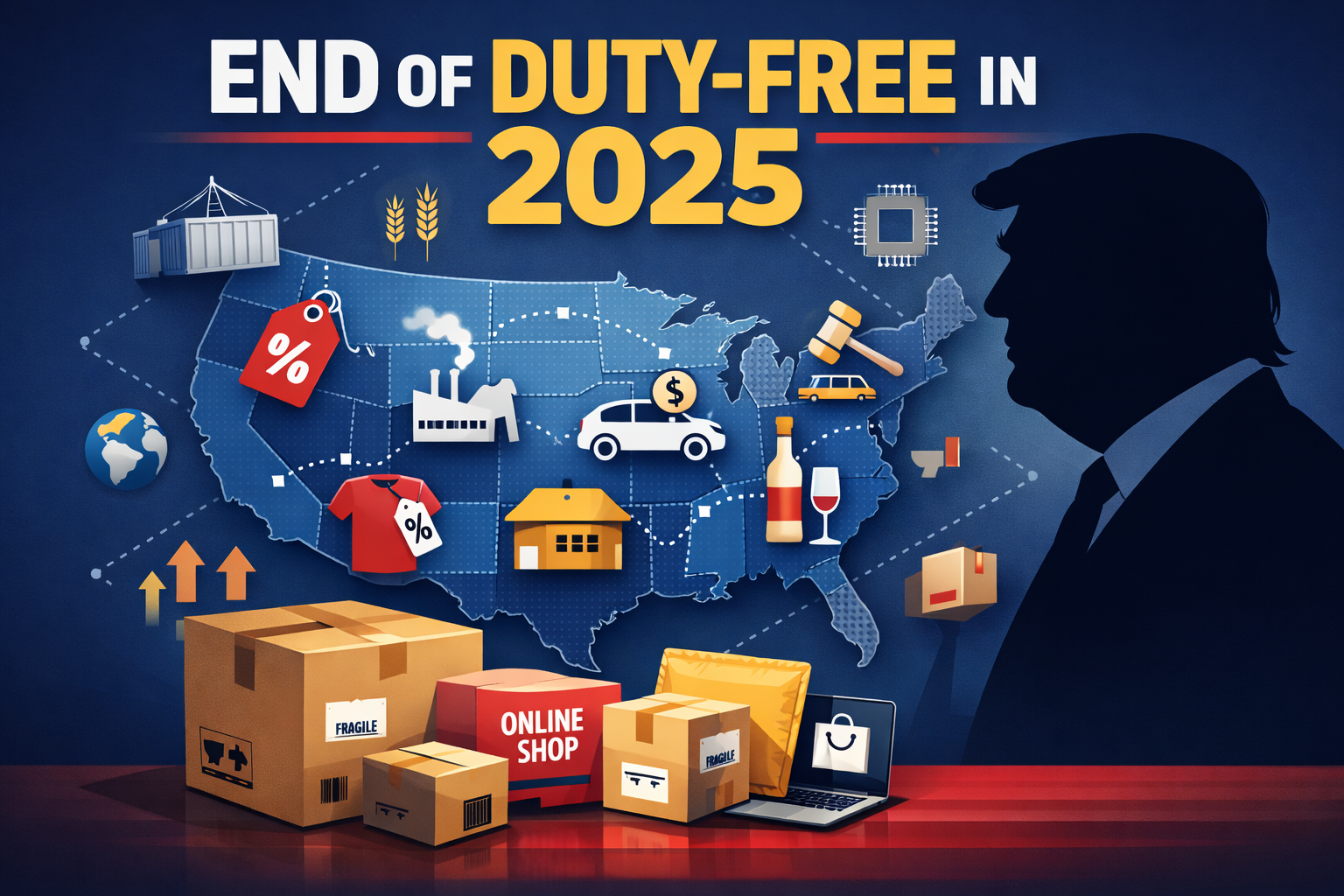
The US eliminated the $800 de minimis duty-free exemption in 2025, effective August 29. All parcels shipped to the United States — regardless of value — are now potentially subject to customs duties and taxes. Ecommerce sellers and logistics warehouses must now provide accurate HTS code classification and customs documentation for every US-bound shipment.
In 2025, the United States implemented major changes to its customs and tariff policies that affect global trade, ecommerce, and international logistics. One of the most impactful updates is the complete elimination of the long-standing de minimis duty-free exemption, a threshold that previously allowed low-value shipments to enter the U.S. without duties. This shift has significant implications for merchants, importers, and logistics warehouses around the world.
What Is the De Minimis Duty-Free Exemption?
For years, the U.S. allowed packages valued at less than $800 to enter the country without paying customs duties and taxes. This rule — known as the de minimis exemption — played a key role in the growth of cross-border ecommerce by reducing costs for small parcels.
However, effective August 29, 2025, U.S. Customs and Border Protection (CBP) fully suspended this exemption, meaning that all incoming shipments are now potentially subject to duties and taxes, regardless of value.
According to U.S. Customs and Border Protection data, the de minimis program had grown to cover over 1 billion shipments per year before its elimination — a volume driven largely by the rapid growth of cross-border ecommerce from China and Southeast Asia. The scale of exempted packages had become a significant concern for customs revenue and enforcement capacity.
Why the Change Was Made
The decision to end the de minimis exemption was driven by concerns over revenue loss, trade fairness, and improper use of the exemption. The U.S. government sought to strengthen customs enforcement and ensure that all goods entering the country are properly declared and taxed. These changes require merchants and logistics providers to reassess how they handle international shipments to the U.S.
Key Dates for the 2025 U.S. Customs Changes
- May 2, 2025: De minimis exemption removed for goods imported from China and Hong Kong.
- April 2–5, 2025: Broader tariff updates and enforcement notices announced.
- August 29, 2025: De minimis exemption fully suspended for all countries.
How These Changes Impact Ecommerce and Logistics
Eliminating the de minimis exemption affects ecommerce merchants, logistics warehouses (including fulfillment centers and 3PLs), and importers in several ways:
- All parcels are now subject to duties and taxes, even those previously below the duty threshold.
- Accurate customs documentation is now more critical than ever to avoid delays and penalties.
- Import cost forecasting becomes essential to maintain profitability.
- Warehouse operations must adapt to more complex customs clearance requirements.
- Customer expectations must be managed regarding additional duties and delivery times.
Based on ShippingToGo's analysis of US-bound shipments, merchants who invest in automated HTS classification and customs document generation reduce customs-related delays by a significant margin compared to those using manual processes. The upfront investment in compliance infrastructure pays off quickly in reduced re-work and fewer shipment holds at US ports of entry.
Before and After: How the Rule Change Affects Your Shipments
| Factor | Before August 29, 2025 | After August 29, 2025 |
|---|---|---|
| Duty-free threshold | $800 per shipment | No duty-free threshold |
| Required documentation | Minimal for sub-$800 packages | Full commercial invoice + HTS codes required |
| Customs processing time | Streamlined for low-value parcels | Standard inspection process for all shipments |
| Landed cost calculation | Optional for small shipments | Mandatory for accurate pricing |
| Shipments from China/HK | Exemption applied (before May 2) | No exemption (from May 2) |
Common Challenges Under the New Policy
Businesses facing the updated U.S. customs regime encounter several key challenges:
- Misclassification of products due to incorrect HS/HTS codes, leading to errors in duty calculation.
- Incomplete or inaccurate documentation, causing delays at customs checkpoints.
- Unexpected duties and taxes that cut into profit margins or surprise end customers.
- Manual customs processes that slow fulfillment and create administrative overhead.
Understanding HTS Codes for US Imports
Every product entering the US must be classified with a 10-digit HTS (Harmonized Tariff Schedule) code. The first six digits follow the internationally standardized HS code system used by 200+ countries; the remaining four digits are US-specific and determine the exact duty rate and regulatory requirements applied to each product category.
Common mistakes that trigger CBP inspections include:
- Using overly generic product descriptions ("general merchandise")
- Applying the same HTS code across fundamentally different product variants
- Failing to update codes when product specifications change
- Copying competitor codes without verifying applicability to your specific products
How ShippingToGo Helps You Navigate the 2025 Customs Changes
ShippingToGo is designed to help merchants and logistics warehouses handle the complexity of the updated U.S. customs environment. From duty calculation to compliance, the platform automates critical steps in the shipping process so businesses can operate efficiently and confidently.
- HS/HTS Code Precision: Ensures correct classification to comply with customs requirements and avoid penalties.
- Customs Documentation Generation: Automatically produces all required forms for U.S. import compliance.
- Integration with Ecommerce & Warehouse Systems: Connects seamlessly with ecommerce platforms, WMS, and ERP systems for smooth data flow.
- Pre-Shipment Cost Transparency: Merchants know total landed cost up front, avoiding surprises for themselves and their customers.
Advantages for ShippingToGo Customers
By using ShippingToGo, businesses benefit from:
- Fewer customs delays in U.S. ports of entry.
- Reduced risk of fines and compliance issues.
- Improved customer satisfaction with clearer duty expectations.
- Streamlined logistics workflows that scale with business growth.
- Full visibility and control over international shipping costs.
Frequently Asked Questions
What happened to the US de minimis exemption in 2025?
The US eliminated the $800 de minimis exemption in two phases: first for goods from China and Hong Kong on May 2, 2025, then for all countries on August 29, 2025. All incoming shipments to the US are now potentially subject to customs duties and taxes regardless of declared value.
What was the de minimis threshold before it was eliminated?
The threshold was $800 per shipment. Packages declared below this value could previously enter the US duty-free under Section 321 of the Tariff Act. This rule had enabled massive growth in cross-border ecommerce, with CBP processing over 1 billion de minimis packages per year at its peak.
How does the 2025 US customs change affect ecommerce sellers?
Every US-bound parcel now requires accurate HTS classification, a commercial invoice, and customs declaration regardless of value. Duty and tax costs must be factored into product pricing for all US customers. Incorrect documentation causes delays, inspections, and potentially penalties — making customs automation essential for any ecommerce seller shipping to the US.
What documents are required for shipping to the US in 2025?
All commercial shipments to the US require: a commercial invoice (with HTS codes, declared value in USD, product descriptions, and shipper/recipient details), a packing list, and a customs declaration form. ShippingToGo's platform generates all required documentation automatically when you book a shipment.
What is an HTS code and why does it matter?
An HTS code is a 10-digit US product classification number used by CBP to calculate import duties. The first 6 digits are internationally standardized (HS code); the remaining 4 are US-specific. The correct HTS code determines your exact duty rate — misclassification triggers re-assessment, holds, and potential fines.
Can ShippingToGo help with US customs compliance?
Yes. ShippingToGo automates HTS code validation, customs document generation, and landed cost calculation for all US-bound shipments. The platform integrates with ecommerce platforms and WMS systems to ensure every package is correctly classified and documented before it ships.
Conclusion: Shipping Smart in 2025
The 2025 changes to U.S. customs policy — especially the elimination of the de minimis exemption — represent a major shift for global ecommerce and logistics. Manual or ad-hoc customs processes are no longer sufficient for successful cross-border operations.
With ShippingToGo, businesses can automate customs compliance, reduce risk, and maintain predictable delivery experiences, allowing them to focus on growth rather than administrative burdens.
Speak With Our Team & Learn More
Related guides:
