

The fastest international shipping option is express air courier, with DHL, FedEx, and UPS delivering to major cities in 1–3 business days. Economy services take 5–10+ days at 30–60% lower cost. This guide explains how to choose the right carrier, avoid volumetric weight surprises, prepare customs documents, and book the fastest path from pickup to delivery.
Moving parcels across borders quickly is about more than choosing the brand with the biggest planes. This guide explains how to evaluate speed vs. price, avoid surprises with volumetric weight, prepare documents for smooth customs clearance, and decide when express is worth it. Throughout, we show how ShippingToGo helps compare options and book the right service for each shipment.
How to Choose the Right International Courier
Different carriers excel at different things: time-definite delivery on specific lanes, temperature-controlled logistics, dangerous goods, remote-area coverage, or simply low cost for less urgent parcels. Choosing "the fastest" means matching your shipment's constraints with the lane where a courier is consistently strong. Ask these questions before you book:
- Transit time commitment: Is there a delivery window (e.g., 1–3 business days) and a money-back guarantee on delays?
- Cut-off time & pickup: Can a pickup today still make tonight's flight? What's the latest drop-off time near you?
- Lane performance: How does the carrier perform between your origin and destination over the past quarter?
- Remote area rules: Are there surcharges or slower legs for islands, rural areas, or PO boxes?
- Service inclusions: Does the price include brokerage, fuel, and extended liability, or will fees be added later?
Tip: run a quick comparison in ShippingToGo's calculator. You'll see live rates, transit estimates, and surcharges across multiple carriers for the same parcel details.
Based on ShippingToGo's shipping data, customers who compare at least two carrier options save 18–25% on average compared to booking with the first carrier they find. DHL operates in 220+ countries and territories, while FedEx and UPS each maintain networks spanning 200+ countries.
Express vs. Economy: Which Is Really Faster?
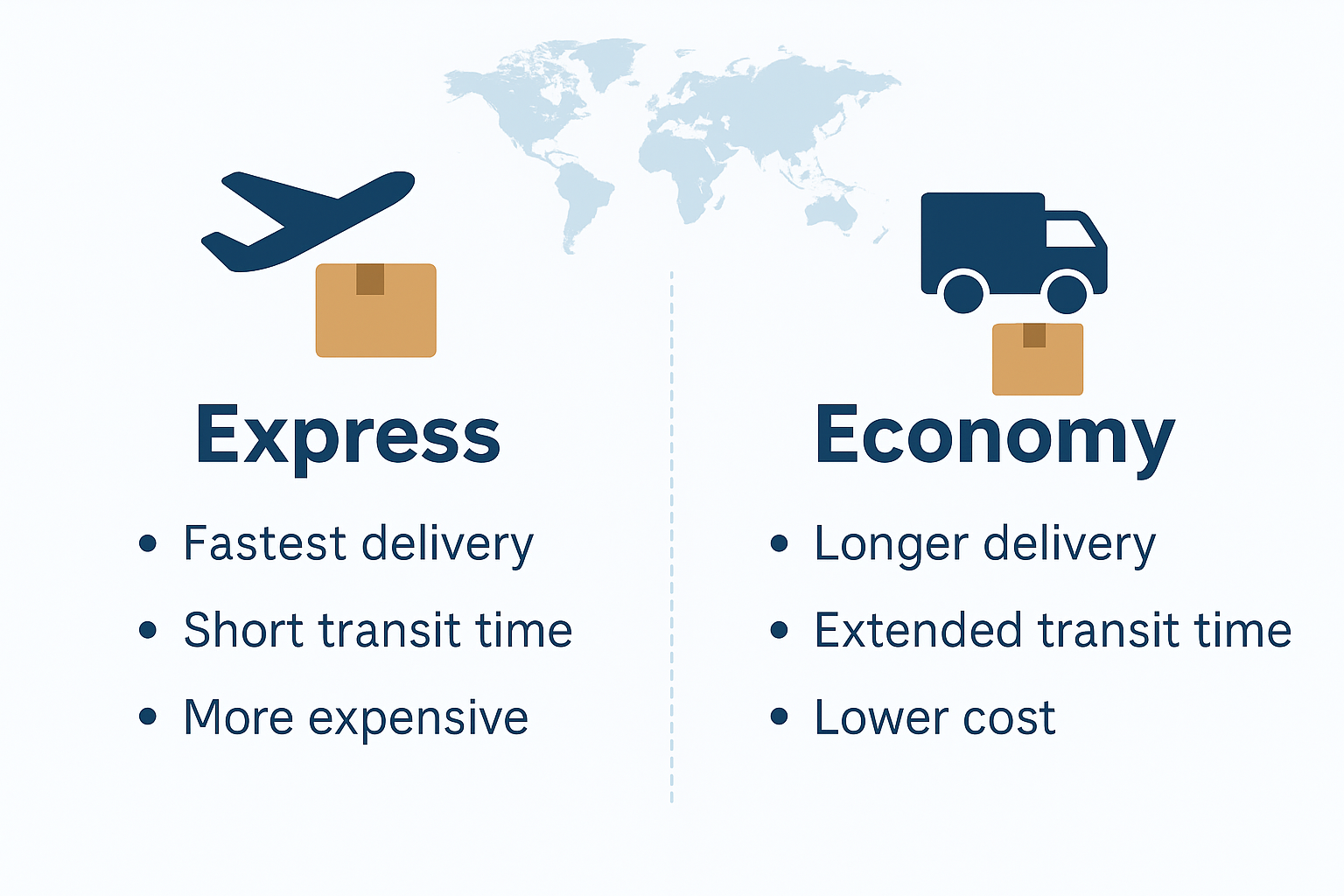
Express air uses dedicated air networks with customs brokerage baked into the service. It's the best choice for deadlines, samples, or high-value goods. Expect 1–3 business days to major cities and a premium price. By contrast, economy leverages consolidated line-hauls, postal partners, or ocean/road legs. Transit is longer (5–10+ days) but the price can be 30–60% lower.
- Choose express for launches, perishables, medical or lab items, repair RMA loops, or where customer experience is critical.
- Choose economy for non-urgent e-commerce replenishment, bulk inventory, or when unit margins are tight.
Volumetric Weight: The Pricing Trap to Get Right
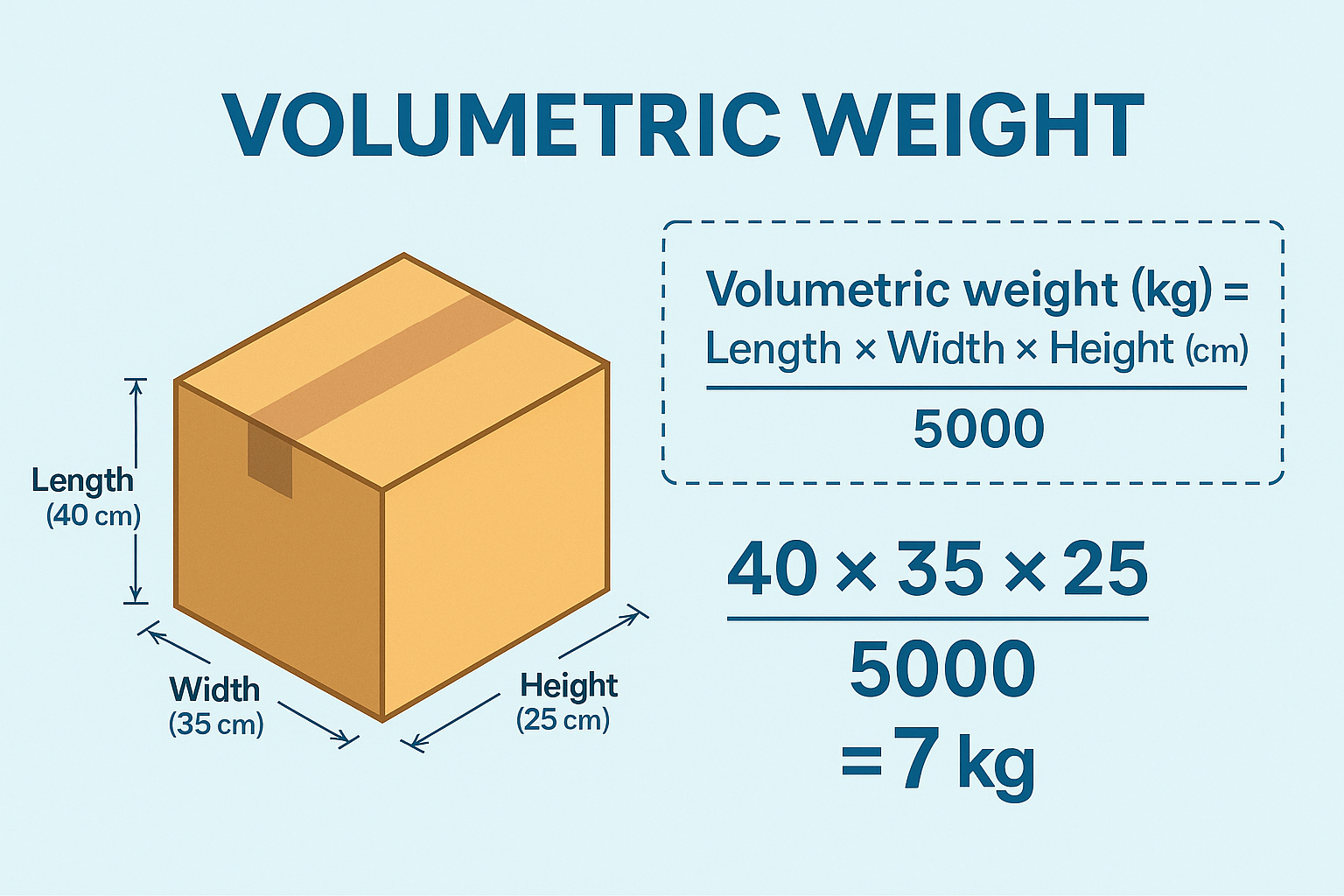
Couriers bill by the higher of actual weight and volumetric (dimensional) weight to reflect aircraft space, not just mass. For parcels measured in centimeters, the standard divisor is 5000.
Volumetric weight (kg) = (Length × Width × Height in cm) ÷ 5000
A 40×35×25 cm box weighs 7 kg volumetric (40×35×25 ÷ 5000) even if the physical weight is only 2.8 kg. Pack efficiently, remove empty air, and choose the smallest sturdy carton that protects your goods. If sending multiples, evaluate whether two smaller boxes cost less than one large one.
Customs, Duties & Documents
Speed collapses if paperwork is wrong. Prepare a clear commercial invoice, a precise packing list, and select the correct HS codes. Declare realistic values, specify the purpose (sale, sample, repair), and include receiver contact details for tax notification. Some products (batteries, cosmetics, food, medical devices) may require permits or certificates of origin.
Decide on DDU vs. DDP (who pays duties/taxes). DDP usually shortens receiver friction but requires you to handle tax remittance. If you ship frequently to the same country, consider a tax account or local importer of record service.
ShippingToGo's booking flow provides fields for HS codes and invoice details and can generate documents automatically from your order data to reduce errors.
Insurance, Tracking & Delivery Confidence
International routes introduce more hand-offs and longer dwell times. Choose services with end-to-end tracking and enable delivery options such as adult signature or pickup point collection if the recipient is often away. For shipments above your risk tolerance, add cargo insurance (carrier liability is limited by convention).
- Set SMS/email alerts so the receiver can pay duties early and avoid missed deliveries.
- For returns, print a prepaid label or provide a QR code to speed up the process.
Fast International Couriers Compared
| Courier | Typical Express Speed | Strengths | Limitations | When to Choose |
|---|---|---|---|---|
| DHL | 1–3 business days | Global coverage (220+ countries), strong customs handling, reliable tracking | Premium pricing on some lanes | Time-critical exports, complex destinations |
| FedEx | 1–3 business days | Fragile/temperature-controlled options, reliable express network | Extra fees for certain special services | High-value or sensitive goods |
| UPS | 1–4 business days | Dense global network, priority services | Limited temperature-controlled options | Urgent B2B deliveries, predictable pickups |
| USPS / Postal partners | 3–8 business days (priority express intl.) | Budget-friendly, broad last-mile reach | Longer transit and fewer guarantees | Cost-sensitive small parcels |
| Royal Mail / Parcelforce | 2–4 business days | Strong UK coverage, multiple tracked options | Heavier parcels may route via partners | UK-centric exports and returns |
| Canada Post | 2–5 business days | Domestic coverage, e-commerce friendly | Remote-area surcharges | Canada deliveries with postal convenience |
| Australia Post | 2–5 business days | Reliable eParcel, regional reach | Lane-dependent express capacity | AU origin with national pickup needs |
| DB Schenker | Time-definite by lane | Air/sea/road multimodal, B2B freight | Heavier documentation and cut-offs | Freight or hybrid shipments |
* Transit times are indicative and vary by origin, destination, cut-off time, and customs complexity.
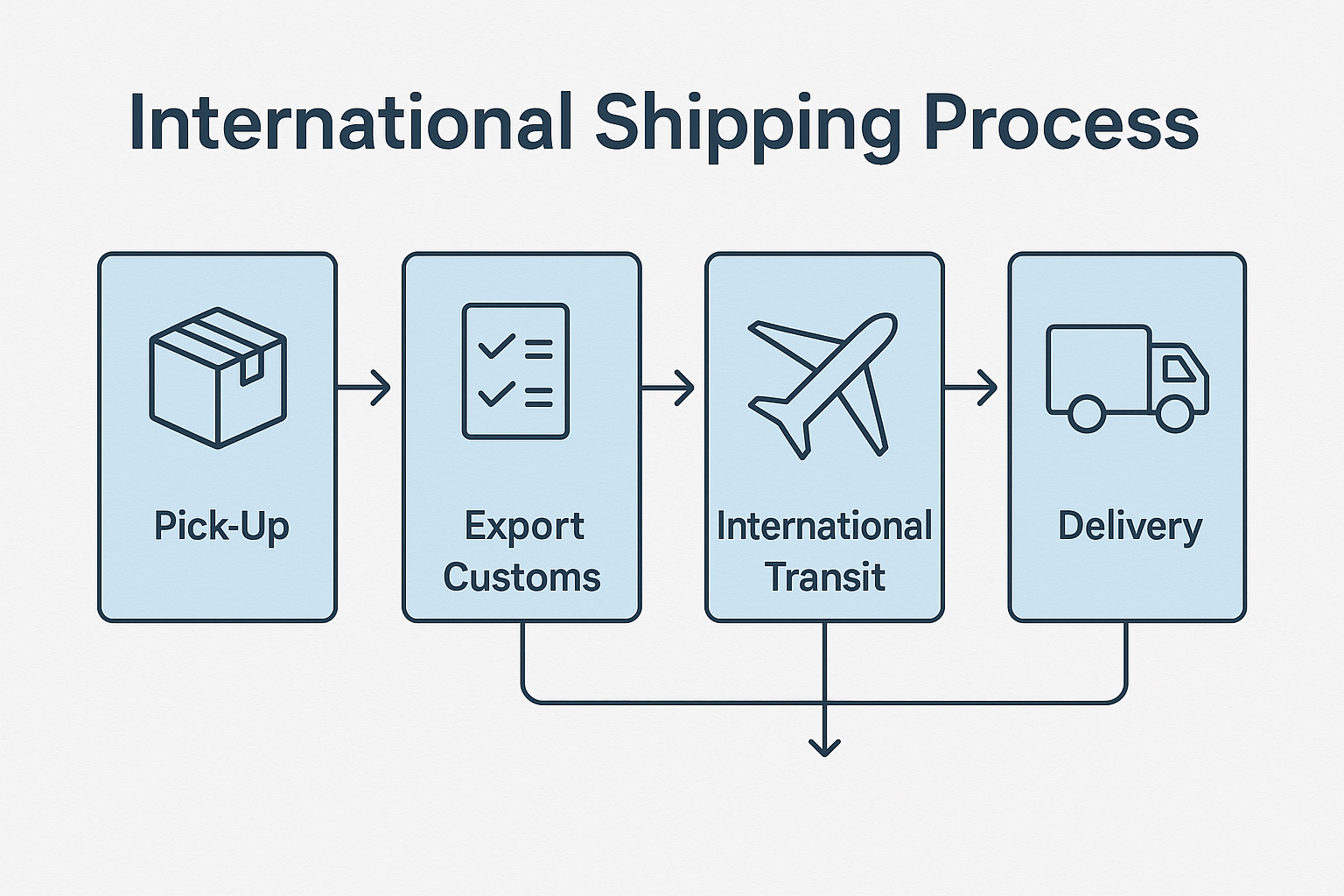
Step-by-Step: Your Fastest Path from Pickup to Delivery
- Quote: Enter dimensions, weight, origin, destination and value in ShippingToGo's calculator. Compare express vs. economy and check pickup cut-off.
- Book: Choose the service, select signature/insurance, and confirm your pickup or drop-off.
- Pack: Use a snug, sturdy carton. Fill voids with cushioning. Place the invoice in a pouch on the outside.
- Label: Print a scannable label. Avoid covering barcodes with tape. Add a return address on the box.
- Track: Share tracking with the receiver. Enable alerts for customs and delivery attempts.
- Deliver: If the receiver misses the courier, redirect to a pickup point or schedule redelivery from the tracking page.
Common Mistakes (and How to Avoid Them)
- Under-declaring value: This risks delays or fines. Declare realistic values and the correct Incoterms.
- Oversized packaging: Paying for volumetric weight you don't need. Choose the smallest safe carton.
- Vague descriptions: "Samples" is not enough. Use clear product names and HS codes.
- No receiver phone/email: Customs can't reach them to collect duties — parcels sit in bond.
- Missing export permits: Batteries, cosmetics, chemicals, and food may require permits. Check before booking.
Frequently Asked Questions About International Shipping
What is the fastest international shipping option?
Express air courier is the fastest option, with DHL, FedEx, and UPS delivering to major cities in 1–3 business days. Speed depends on origin, destination, and cut-off times. Compare real-time transit estimates across all carriers on ShippingToGo to find the fastest option for your specific route.
What is volumetric weight and how is it calculated?
Volumetric weight = Length × Width × Height (cm) ÷ 5000. Couriers charge the higher of actual and volumetric weight. A 40×35×25 cm box has a volumetric weight of 7 kg even if it physically weighs 2.8 kg. Always pack in the smallest safe carton to minimize unnecessary volumetric weight charges.
What documents are needed for international shipping?
Required documents include: commercial invoice with goods description and declared value, accurate packing list, and correct HS codes. Some goods (batteries, cosmetics, food, medical devices) require permits or certificates of origin. ShippingToGo's booking flow generates these documents automatically from your order data.
Is express international shipping always worth the premium?
Use express when the cost of being late is higher than the premium — for launches, returns that unlock cash flow, or medical items the answer is usually yes. For non-urgent replenishment or bulk inventory where margins are tight, economy services at 30–60% lower cost are the better choice.
Which international courier is best: DHL, FedEx, or UPS?
DHL excels in global coverage (220+ countries) and customs handling. FedEx is strongest for fragile and temperature-controlled shipments. UPS offers dense network coverage and reliable B2B express. The best choice depends on your specific origin, destination, and shipment requirements. Compare all three on ShippingToGo to see which performs best on your route.
Can I ship dangerous goods internationally?
Yes, but only with designated services and correct packaging and labels. Declare accurately and include Material Safety Data Sheets (MSDS) when required. Battery-containing devices, aerosols, and hazardous chemicals each have specific packaging and documentation requirements. Confirm compliance with your carrier before booking.
Looking for country-specific guidance? See our destination pages: USA · UK · Australia · Canada.
