

Shipping a laptop internationally via express courier costs $40–$120 and takes 2–5 business days to most destinations. Use DDP (Delivered Duty Paid) to prevent unexpected customs charges for employees. IATA lithium battery regulations require specific packaging and labeling. ShippingToGo enables tech companies to manage multi-country IT equipment shipping from one centralized platform.
As remote work becomes the standard in the tech industry, companies are increasingly required to ship IT equipment internationally to employees across multiple countries.
Laptops, monitors, docking stations, servers, networking devices — these are no longer shipped only to office locations. They are sent directly to remote employees worldwide.
However, international shipping of IT equipment is far more complex than sending a regular parcel. Customs regulations, lithium battery restrictions, declared value issues, and import duties can all create delays and unexpected costs.
This guide explains how tech companies can ship IT equipment internationally in a structured, efficient, and scalable way.
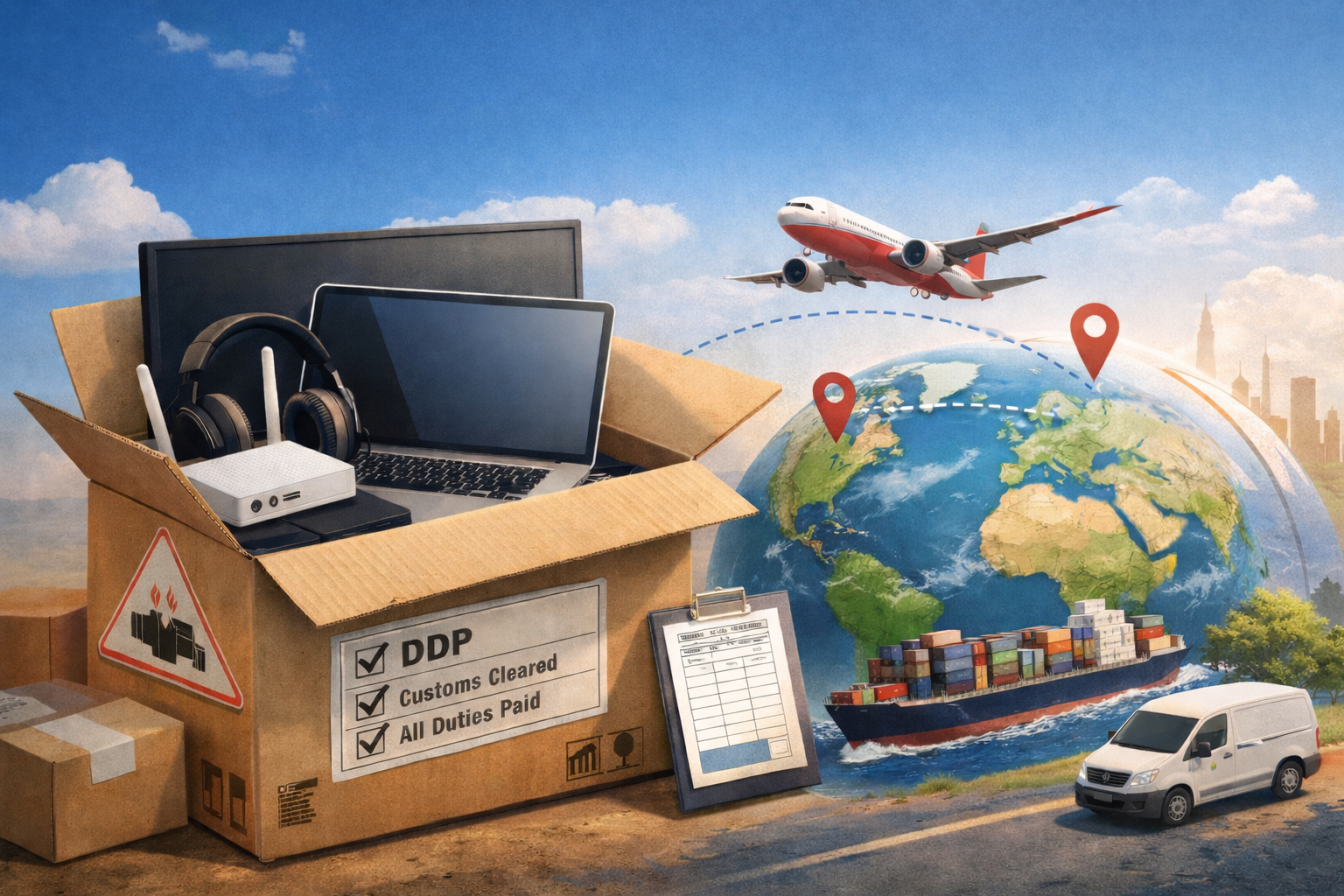
Why Tech Companies Ship IT Equipment Globally
Modern tech companies operate with:
- Distributed engineering teams
- Remote-first hiring strategies
- International contractors
- Satellite offices across continents
To maintain productivity and security standards, companies must provide:
- Company-issued laptops
- Monitors and ergonomic equipment
- Secure networking hardware
- Development or testing devices
According to Statista, the global remote workforce has grown significantly, with over 30% of information workers now working remotely in some capacity across key tech markets. Shipping IT equipment internationally has become part of standard operational workflow for hundreds of companies globally.
Shipping IT equipment internationally has become part of standard operational workflow.
The Key Challenges of Shipping IT Equipment Internationally
1. Customs and Import Regulations
Each country has different rules for importing electronics. Incorrect HS codes or inaccurate declared values can cause:
- Shipment delays
- Customs inspections
- Additional taxes
- Storage fees
Electronics are highly regulated items, and documentation must be precise. The correct HS code for laptops is 8471.30; for monitors, it is 8528.52. Always verify with a customs broker for the specific destination country.
2. Lithium Battery Restrictions
Most laptops and many devices contain lithium batteries. IATA (International Air Transport Association) air freight regulations impose strict requirements on:
- Packaging standards — lithium batteries must be protected against short-circuit
- Battery labeling — IATA-compliant labels must be affixed to outer packaging
- Quantity limitations — restrictions on number of devices per shipment
- State of charge — batteries must not exceed 30% charge for cargo-only aircraft
Failure to comply may result in shipment rejection at origin or confiscation at destination. According to IATA, lithium battery incidents are among the leading causes of air cargo safety events, which is why these regulations are strictly enforced.
3. Duties and Taxes (DDP vs DDU)
One of the most common questions is: Who pays the import duties?
If shipments are sent DDU (Delivered Duty Unpaid), the remote employee may be asked to pay customs fees upon delivery — creating friction and a poor employee experience.
DDP (Delivered Duty Paid) ensures the company covers duties upfront, preventing unexpected charges for employees. Based on ShippingToGo's analysis, companies that switch from DDU to DDP for employee equipment shipping report significantly fewer delivery failures and support tickets related to customs charges.
| Factor | DDP (Delivered Duty Paid) | DDU (Delivered Duty Unpaid) |
|---|---|---|
| Who pays customs duties | Sender (company) | Recipient (employee) |
| Employee experience | Smooth, no surprises | May receive unexpected bill |
| Delivery success rate | Higher | Lower (delays if employee absent) |
| Cost to company | Higher upfront | Lower upfront, higher support cost |
| Recommended for | Remote employee onboarding | B2B where recipient manages customs |
4. High Declared Value and Insurance Needs
IT equipment is expensive. A single laptop shipment may be worth $1,500–$3,000.
Without proper insurance coverage, companies risk:
- Financial loss from damage or theft in transit
- Delays in replacement causing productivity downtime
- Employee dissatisfaction during onboarding
5. Multi-Country Shipping Complexity
Tech companies often ship equipment to 5–15 countries simultaneously, with new hires every month and contractors in different tax jurisdictions. Managing shipments manually through multiple courier accounts quickly becomes inefficient and error-prone.
Best Practices for Shipping IT Equipment to Remote Employees
Plan Before Hiring Starts
If your company hires globally, integrate international shipping into your onboarding workflow. Prepare standard equipment kits, pre-defined declared values, and pre-approved shipping methods for each target country before the first hire in that location.
Choose the Right Shipping Model
Depending on urgency and destination, choose between:
- Express air freight (2–5 business days) — for new hires with a set start date
- Economy international shipping — for advance planning and cost savings
- Bulk consolidated shipments — when outfitting multiple employees in the same country
Use Accurate Documentation
Ensure every shipment includes:
- Correct product descriptions (e.g., "Laptop Computer, MacBook Pro 14-inch")
- Accurate HS codes (8471.30 for laptops)
- Realistic declared values — never undervalue IT equipment
- Proper commercial invoice formatting (sender, recipient, item list, total value)
This reduces customs clearance delays and prevents penalties for misdeclaration.
Consider DDP for Better Employee Experience
Covering duties and taxes centrally prevents payment requests to employees, delivery delays, and internal support tickets. A smooth delivery experience significantly improves onboarding satisfaction and signals professionalism to new team members.
Centralize All Shipments in One Platform
Instead of managing multiple courier websites, email threads, and manual tracking spreadsheets, use a centralized international shipping solution that allows self-service shipment generation, multi-country management, centralized documentation, cost comparison, and operational visibility.
Why ShippingToGo Is Built for Tech Companies
ShippingToGo understands the operational reality of global tech teams. We provide:
- Centralized international shipment management
- Easy shipment creation through one interface
- Support for electronics and lithium battery shipments
- Structured documentation workflows
- Cost-efficient global delivery options
Instead of treating each shipment as an isolated action, we help tech companies turn international IT shipping into a controlled and scalable process. Based on ShippingToGo's analysis, companies that centralize IT equipment shipping through a single platform reduce per-shipment administrative time by approximately 60% compared to managing multiple courier accounts manually.
Country-Specific Considerations for IT Equipment Shipping
| Region / Country | Transit Time | Key Customs Consideration | DDP Recommended? |
|---|---|---|---|
| European Union | 2–4 days | CE marking may be required; VAT applies | Yes |
| UK (post-Brexit) | 2–3 days | Full customs declaration required; 20% VAT | Yes |
| United States | 3–5 days | FCC certification for electronics | Recommended |
| India | 5–10 days | Complex import duties; prior approval may be needed | Strongly Yes |
| Brazil | 7–15 days | High import duties (up to 60%); IBAMA restrictions | Essential |
| Singapore | 3–5 days | Low duties; efficient customs clearance | Recommended |
Frequently Asked Questions — Shipping IT Equipment Internationally
How long does it take to ship a laptop internationally?
Express international shipping typically takes 2–5 business days, depending on destination and customs clearance. DHL, FedEx, and UPS all offer express services for IT equipment. Countries with more complex customs procedures (Brazil, India) may add 3–10 additional business days for import clearance at destination.
Can lithium battery devices be shipped internationally?
Yes, but they must comply with IATA air freight safety regulations and packaging requirements. Laptops require specific labeling, packaging standards, and restrictions on battery state of charge. ShippingToGo assists tech companies in ensuring all lithium battery shipments are properly prepared and compliant.
Should companies choose DDP or DDU for remote employees?
DDP (Delivered Duty Paid) is strongly recommended for remote employee equipment shipments. Under DDU, employees may receive unexpected customs bills at their door, creating friction. DDP means the company pays all import duties upfront, ensuring smooth delivery and a professional onboarding experience.
Can multiple countries be managed simultaneously through one platform?
Yes. A centralized shipping system like ShippingToGo allows tech companies to manage multi-country IT equipment shipments from a single dashboard. Generate labels, compare rates, track shipments, and manage documentation for 5–50 countries simultaneously without managing separate courier accounts.
What HS code should I use for shipping laptops internationally?
Laptops are classified under HS code 8471.30. Desktop computers are 8471.41 or 8471.49. Monitors are 8528.52. Using the correct HS code is essential — incorrect classification can trigger customs delays, fines, or incorrect duty charges. Verify with your customs broker or ShippingToGo's documentation team for your specific shipment.
How much does it cost to ship a laptop internationally?
Shipping a laptop via express courier costs approximately $40–$70 to Europe (2–3 days), $60–$100 to most of Asia (3–5 days), and $80–$150 to more distant or complex destinations (5–7 days). Compare exact rates by destination on ShippingToGo, including all-in pricing with duties when choosing DDP.
Conclusion
Shipping IT equipment internationally is now a core operational requirement for tech companies with global teams. To do it effectively, organizations need regulatory awareness, proper documentation, lithium battery compliance, and centralized operational control.
With the right structure and the right partner, international IT shipping becomes predictable, scalable, and efficient. ShippingToGo enables tech companies to manage global equipment shipping with simplicity, control, and speed.
Talk to Our Team About Shipping IT Equipment Internationally
