

Sea freight carries approximately 90% of world trade by volume and is the most cost-effective method for large international shipments. Transit times range from 20 to 60 days depending on route, compared to 1–5 days for air freight. For shipments over 500 kg or 3 CBM, sea freight is almost always significantly cheaper — compare options at ShippingToGo.
Sea shipping sea freight refers to international shipping of commodities by sea.
The most common method for sending products internationally is by far sea shipping.
Approximately 90% of goods are shipped by water around the world. However, just because something is popular does not automatically make it the best alternative.
The majority of business owners discover that they occasionally need to reassess their shipping alternatives, regardless of how experienced they are with international shipping or if they are just getting started.
ShippingToGo can assess if you need to determine whether sea shipping makes sense in your business.
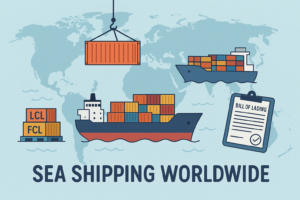
What is Sea Shipping Worldwide?
Transporting products through the water is known as ocean freight.
It is a crucial component of cross-border trade that enables people to transport enormous volumes of products between nations.
Usually, ships are used to transfer the commodities across the ocean.
For various commodities, there are numerous shipping alternatives available.
Container shipping, often known as containerization, is one of the most common. With this choice, products are carried in containers that typically range in size from 20 to 40 feet.
Although exporting little amounts by ocean is undoubtedly expensive, it scales quite nicely.
For larger shipments, it results in a cheaper total cost.
This explains why it has become such an important part of global trade. Despite this, sea transportation is significantly slower, with most cargo arriving in 40 to 60 days on average.
Types of Sea Shipping Services
Container shipping is among the most famous ocean freight options.
This is primarily due to its comparative security and ease of use.
When it comes to containerization, there are basically two types of services available:
- LCL (Less Container Load)
- FCL (Full Container Load)
FCL Shipping (Full Container Load)
FCL shipments entail shipping your goods in one or maybe more containers that you exclusively use. The container will only contain your goods, ensuring that your shipping will remain untouched until you open it yourself.
When you have products that can fill or nearly fill a container, this option is the most sensible.
LCL Shipping (Less Container Load)
The goods aimed to be shipped are generally less than what it takes to fill a container with LCL shipments.
So, instead of owning a container, which can be costly, you can split the expense and share the container with other people's goods.
However, the disadvantage of this choice is that your commodities may be more susceptible to improper handling or harm during the voyage.
| Feature | FCL (Full Container Load) | LCL (Less Container Load) |
|---|---|---|
| Container use | Exclusive — only your goods | Shared with other shippers' goods |
| Best for | Large shipments (>15 CBM) | Small to medium shipments (<15 CBM) |
| Cost basis | Fixed per container | Per cubic meter or ton |
| Transit time | Direct port-to-port | Slightly longer (consolidation adds time) |
| Security risk | Lower — no cargo mixing | Slightly higher — shared container |
How to Ship Using Ocean Shipping?
Ocean shipping, also known as sea shipping, is heavily reliant on the services of third-party freight forwarders.
Freight forwarders are typically defined as a third-party person or company who picks up your commodities, properly arranges them to be packed and onboard for shipments, and then delivers them to their final destination.
The shipment contract is another important aspect of the process that you should be aware of. Ocean shipping contracts are governed by standard international shipping terms.
These are known as "Incoterms," which stand for global commercial terms. They specify how far along the procedure the seller will be held liable for the goods, and when the buyer will assume responsibility for the shipment.
The Most Popular Incoterms Are:
FOB (Free on Board): Sellers and buyers share responsibility for the delivery process under the FOB agreement. The seller is responsible for ensuring that the goods are properly packaged, labelled, and loaded for shipping. The obligations pass to the buyer once the goods are loaded onboard.
EXW (Ex Works): An EXW contract places the buyer in charge of the majority of the work. The buyer collects the goods from the manufacturer and is liable for their transportation to their ultimate stop.
DDP (Delivered Duty Paid): With DDP, the seller assumes all obligations while the buyer assumes none. According to the terms, the seller is accountable for the costs of shipping, insurance, and inland transportation.
The Six Stages of Ocean Freight
Following the determination of your shipment terms, the process of completing the ocean freight will include the following stages:
- Export haulage: Your products will be shipped from the seller's warehouse to the warehouse of your freight forwarder.
- Export customs clearance: Most places require that goods intended for export be cleared first. Clearance will entail providing a detailed cargo declaration as well as supporting documentation.
- Origin handling: The cargo will be transferred to a staging point for checking and confirmation. The freight forwarder will issue a cargo invoice confirming receipt of the goods. FCL goods are loaded into their container; LCL goods are placed in a warehouse to await consolidation.
- Ocean transit: The shipment travels by sea to the destination port.
- Import customs clearance: Once the package arrives at the destination port, it must be cleared for import. This entails filling out the necessary forms, declaring the cargo, and paying applicable fees.
- Import haulage: The products are transferred inland by train or truck to the specified final destination.
Every stage of the process can be delegated to the freight forwarder. Alternatively, you may choose to make other arrangements.
How are Sea Shipping Rates Calculated?
Ocean freight rates are typically determined by a number of charges, including the cost per weight of goods and the amount of space they occupy.
Ocean freight costs roughly around $0.50 per kilogram as a base rate. Other fees that may be added to the freight rate include:
- Customs security surcharge
- Routing charges
- Fuel surcharge
- Customs brokerage
- Insurance
- Container freight station (this applies to LCL consolidation only)
- Pickup and delivery at ports and warehouses
Ocean freight rates are not fixed. Depending on a variety of factors, the price could rise significantly or fall even further. Among these elements are:
Fuel prices: Fuel is essential for shipping goods by sea freight, and prices can fluctuate. When prices rise, rates are likely to rise as well.
Rates of exchange: Slight exchange rate fluctuations can result in significant losses for shipping companies, especially given the length of a single trip.
Supply and demand: People often work less during the holidays, which has an impact on the shipping industry. There is generally a spike in demand just before festive holidays such as Chinese New Year, which can drive freight rates up.
Size of shipment: Clearly, larger-sized shipments require a lot more work and cost a lot more. Containerized shipment is effective because it scales well with size. Other types of vessels, such as tanker trucks for liquid cargo or bulk carriers for unbagged dry goods, may be more expensive.
Sea Freight vs Air Freight: When to Choose Each
Based on ShippingToGo's shipping data, the decision between sea and air freight depends primarily on shipment size, time sensitivity, and budget.
| Factor | Sea Freight | Air Freight |
|---|---|---|
| Transit time | 20-60 days | 1-7 days |
| Cost | Low (best for large shipments) | High (5-10x more than sea) |
| Best shipment size | Over 500 kg or 3 CBM | Under 500 kg or 3 CBM |
| Environmental impact | Lower per kg (ship efficiency) | Higher per kg (aircraft fuel) |
| Best for | Bulk goods, furniture, machinery | Electronics, pharmaceuticals, urgent orders |
When does it make sense to choose Sea Shipping?
If you are shipping large or bulky items, or if you need to decrease your shipping costs to save money, you should consider using sea freight. When there is a high volume of orders within a short period of time, ocean freight works very well.
However, if you choose ocean freight, you should generally allow more than enough time for the commodities to arrive. If you do not have adaptable delivery dates, you may want to look elsewhere.
Overall, ocean freight is a great choice for international shipments, but only in certain situations.
It can be a low-cost option, but this is frequently offset by the complexity of the process. Working with an experienced freight forwarder or using ShippingToGo's platform can simplify this significantly.
Frequently Asked Questions About Sea Shipping Worldwide
What is sea freight shipping?
Sea freight shipping (ocean freight) is the transport of goods between countries by ship. It is the most common international shipping method, carrying approximately 90% of global trade by volume. Goods are shipped in 20-foot or 40-foot containers using either FCL (Full Container Load) or LCL (Less Container Load) services depending on shipment size.
How long does sea freight shipping take?
Sea freight transit times vary by route. Most ocean freight takes 20–60 days from port to destination, depending on origin, destination, and whether transshipment is required. China to Europe typically takes 25–35 days, while transatlantic routes from Europe to the US East Coast take approximately 12–16 days port-to-port.
What is the difference between FCL and LCL shipping?
FCL (Full Container Load) means you fill an entire container — best when cargo fills 15+ CBM. LCL (Less Container Load) means your goods share a container with other shippers, paying only for the space used. LCL is cheaper for small shipments but takes slightly longer due to consolidation and deconsolidation at origin and destination.
How are sea freight rates calculated?
Sea freight rates are based on shipment weight or volume (whichever is greater), the route, and surcharges including fuel, customs security, routing, insurance, and container freight station fees for LCL. Ocean freight costs roughly $0.50 per kg as a base, with total costs highly dependent on surcharges, destination port fees, and seasonal demand fluctuations.
When does sea freight make sense vs air freight?
Sea freight makes sense for shipments over 500 kg or 3 CBM, non-time-sensitive goods, bulk commodities, and machinery. Air freight is better for small, high-value, or time-sensitive items. As a rule, the cost difference between sea and air is 5–10x — so if delivery time flexibility exists, sea freight offers major savings for larger loads.
What are Incoterms in sea freight?
Incoterms (International Commercial Terms) define who is responsible for shipping costs, insurance, and risk at each stage of an ocean freight journey. The most common are FOB (Free on Board), EXW (Ex Works), and DDP (Delivered Duty Paid). They determine when responsibility transfers from seller to buyer and affect total shipping cost calculations.
