

Air delivery is the fastest way to ship goods internationally, with transit times of 1-5 business days and costs starting from $5-$8 per kg for standard air freight. Express courier services from DHL, FedEx, and UPS deliver in as little as 1-3 business days. Use ShippingToGo to compare real-time air freight rates across all major carriers.
When it comes to international shipping, businesses need to make fast and accurate decisions — and choosing the right shipping method is one of the most critical. Air delivery is now considered the fastest, safest, and most efficient way to transfer goods from one country to another.
It's not just a transportation solution — it's a real logistical strategy that enables both small and large businesses to meet customer expectations and operate at the pace of the global market. With a sharp increase in demand for air delivery services and technological advancements that streamline the entire process, now is the time to understand why this field has become so essential — and how you too can benefit from the advantages it offers.
Air delivery is undoubtedly the fastest way today to transfer goods from one country to another.
There are many different methods for transporting goods from origin to destination, and choosing the right method can make the difference between a shipment that arrives intact and whole at its destination, and one that arrives damaged, delayed, or doesn't arrive at all. In certain countries worldwide, ground transportation is simply not an option, and air delivery is the only way to ship goods.
It's worth knowing that air freight is one of the fastest-growing industries in North America.
Just to get a sense of scale, the air shipping industry contributes about $50 billion to Canada's GDP and nearly $60 billion to the United States' GDP.
As a result, there is enormous demand for reliable and affordable air shipping services in all regions of the world.
According to the International Air Transport Association (IATA), air freight carries approximately 35% of world trade by value — despite representing less than 1% by volume. This highlights why time-sensitive and high-value goods are disproportionately shipped by air.
If you're looking for the best option for fast shipments, here are some of the main reasons why air delivery has become so popular in recent years.
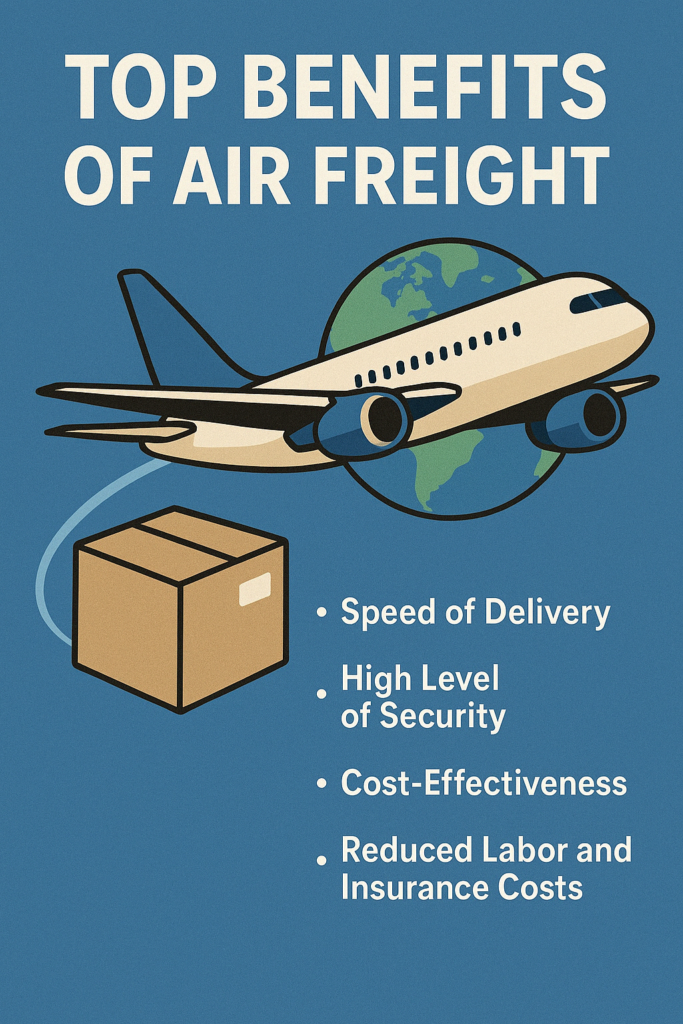
Exploring the Top Benefits of Air Freight
Transporting goods across borders or even continents is a challenge that businesses face regularly. In the realm of logistics, selecting the most suitable transportation method can drastically affect the success of your shipments. Among the various options, air freight has emerged as a preferred choice for many due to its distinct advantages.
Based on ShippingToGo's analysis of shipment data across our platform, the following are the most frequently cited reasons businesses choose air freight over sea or road transport.
| Benefit | Why It Matters | Who Benefits Most |
|---|---|---|
| Speed | 1-5 business days vs. 15-45 days by sea | E-commerce, perishables, urgent orders |
| Security | Strict airport protocols, less handling | High-value goods, electronics, jewelry |
| Reliability | Fixed flight schedules, fewer delays | Businesses with tight supply chains |
| Lower insurance costs | Shorter transit = less time at risk | Luxury goods, pharmaceuticals |
| Reduced warehousing | Faster delivery reduces storage needs | Just-in-time manufacturers |
| Global reach | Serves landlocked and remote destinations | Businesses shipping to any country |
Speed of Delivery
Air freight delivers international shipments in 1-5 business days — compared to 15-45 days for sea freight and 1-14 days for road freight depending on distance. For express courier services, next-day and two-day delivery are available on major routes.
In the fast-paced world of commerce, time is often equated with money. Air freight is invaluable for time-sensitive shipments, offering significantly faster transit times compared to sea or land transport. This speed facilitates quicker inventory turnover and allows businesses to respond promptly to market demands and customer needs.
For small to medium-sized enterprises, this can enhance competitiveness and access to international markets. According to DHL's network data, DHL Express serves 220+ countries and territories with next-business-day delivery available on thousands of routes globally.
High Level of Security
Airports enforce some of the strictest security protocols in the logistics industry. Every shipment passing through an air cargo terminal is screened, weighed, documented, and tracked — reducing the risk of theft, loss, and tampering compared to other transport modes.
Security is paramount in shipping, and air freight excels in this aspect. Airports uphold stringent security measures, reducing the risk of theft and damage. This secure environment makes air freight an ideal choice for transporting valuable or delicate items, ensuring they reach their destination safely.
Cost-Effectiveness
Air freight rates typically range from $5-$8 per kg for standard international shipments, and $10-$20 per kg for express courier services. While this is higher than sea freight on a per-kg basis, the total cost of ownership is often lower when factoring in warehousing, insurance, and working capital tied up in slow-moving inventory.
While air freight might not always be the cheapest option, it can be cost-effective when considering the broader financial implications of faster delivery. For urgent shipments, the cost of air freight can be offset by the economic benefits of having products available at the right time. This is particularly beneficial for industries where speed is crucial, such as fashion or technology.
Based on ShippingToGo's shipping data, businesses shipping time-sensitive goods valued above $50 per kg typically find air freight more cost-effective than sea freight when total supply chain costs are included.
Reduced Labor and Insurance Costs
Air freight can lead to savings in labor and insurance costs. The quicker transportation time reduces the need for extensive warehousing, cutting down on storage costs and minimizing the duration goods are in transit and potentially at risk.
Additionally, the shorter travel time can lower insurance premiums due to reduced exposure to risk. For high-value cargo, insurance rates for air freight can be 30-50% lower than for equivalent sea freight shipments covering the same goods, due to the reduced time in transit.
Lower Risk of Damage and Loss
The streamlined processes of air freight, combined with less handling of cargo, mean there is a minimal risk of damage during transport. Packages are typically loaded directly onto the aircraft and offloaded straight to the delivery truck, reducing the chances of mishandling and damage.
This is essential for fragile or high-value goods. According to IATA data, air cargo has a significantly lower claims rate compared to sea freight — making it the preferred mode for electronics, pharmaceuticals, and luxury goods.
Flexibility
Air freight offers unparalleled flexibility, making it easier to manage shipments that need to meet tight deadlines or are destined for regions without easy access to sea or land routes. This flexibility extends to being able to handle sudden changes in shipment plans or emergency deliveries effectively.
Air Freight vs. Sea Freight: Cost and Time Comparison
Choosing between air freight and sea freight depends on your shipment weight, urgency, and budget. Here is a direct comparison to help you decide.
| Factor | Air Freight | Sea Freight |
|---|---|---|
| Typical cost per kg | $5-$20 | $0.10-$1.00 |
| Transit time | 1-7 business days | 15-45 days |
| Best for weight | Under 500 kg | Over 500 kg / full containers |
| Tracking | Real-time, flight-level | Port-to-port updates |
| Insurance cost | Lower (shorter transit) | Higher (longer transit) |
| Customs processing | 24-48 hours typical | 1-5 days typical |
| Best for | Urgent, high-value, perishable | Bulk, heavy, low-value goods |
Based on ShippingToGo's shipping data, shipments under 150 kg on routes like Dubai to London or Dubai to New York are almost always more economical via air freight when considering the total landed cost — including warehousing saved and faster payment cycles on delivered goods.
How Air Freight Pricing Works: Dimensional Weight Explained
Air freight carriers charge based on whichever is greater — the actual (gross) weight of your shipment or its dimensional (volumetric) weight. Understanding this distinction can prevent unexpected costs.
Dimensional weight formula:
- Measure your package in centimeters: Length x Width x Height
- Divide by 5,000 (the standard IATA divisor)
- Compare the result against actual weight in kg
- You are charged for whichever is higher
Example: A package measuring 50 x 40 x 30 cm weighs 3 kg physically. Its dimensional weight is (50 x 40 x 30) / 5,000 = 12 kg. You will be charged for 12 kg, not 3 kg.
In addition to the base rate, air freight invoices typically include:
- Fuel surcharge (FSC) — varies monthly based on jet fuel prices
- Security surcharge — standard airport security costs
- Destination handling charges
- Customs clearance fee (if handled by the carrier)
- Residential delivery surcharge (for courier services)
According to IATA, fuel surcharges can represent 15-40% of total air freight costs depending on current oil prices — making it important to get all-inclusive quotes rather than base rate quotes when comparing carriers.
Required Documents for Air Freight
Every international air shipment requires a specific set of documents for customs clearance and carrier compliance. Missing documents are the most common cause of delays and additional charges.
Core Documents (Required for Every Shipment)
- Air Waybill (AWB) — The primary contract between shipper and carrier. It is non-negotiable and serves as a receipt, freight bill, and certificate of insurance.
- Commercial Invoice — Describes the goods, their value, and the parties involved. Must include HS (Harmonized System) commodity codes.
- Packing List — Itemizes the contents, quantities, weights, and dimensions of each package.
- Shipper's Letter of Instruction (SLI) — Authorizes the freight forwarder or carrier to act on your behalf.
Additional Documents (Depending on Goods and Destination)
- Certificate of Origin — Required by many countries to determine applicable import duties.
- Import/Export License — Required for controlled goods such as certain chemicals, electronics, or military items.
- Dangerous Goods Declaration — Mandatory for any shipment containing IATA-classified hazardous materials.
- Health Certificate / Phytosanitary Certificate — Required for food products, plants, and organic materials.
- CITES Permit — Required for any shipment involving protected wildlife or wildlife products.
For shipments into and out of the UAE, the UAE customs documentation guide provides a complete overview of requirements by commodity type.
Prohibited and Restricted Items in Air Shipping
Air carriers and aviation regulators maintain strict prohibited items lists. Shipping a prohibited item can result in seizure, fines, and criminal liability. Always verify before shipping.
Absolutely Prohibited (Cannot Be Shipped by Air)
- Explosives and fireworks
- Flammable liquids and solids (above certain thresholds)
- Radioactive materials (except approved medical isotopes with special permits)
- Toxic and infectious substances (without proper classification and packaging)
- Standalone lithium batteries exceeding IATA watt-hour limits
Restricted Items (Require Special Handling or Declaration)
- Lithium batteries installed in devices — must meet IATA packing instructions
- Dry ice — must be declared, quantity limits apply
- Magnetized materials — must be identified and positioned away from aircraft systems
- Aerosols and pressurized containers — quantity limits per passenger/shipment
- Perishable goods — must meet temperature control and packaging standards
The IATA Dangerous Goods Regulations (DGR) manual is updated annually and is the authoritative reference for what may and may not be shipped by air.
How to Book Air Freight: Step-by-Step
Booking air freight through ShippingToGo takes under 5 minutes. Here is the complete process from quote to delivery.
- Enter shipment details — Provide origin, destination, number of packages, weight per package, and dimensions.
- Compare carrier rates — ShippingToGo displays real-time rates from DHL, FedEx, and UPS side by side, showing total price including surcharges.
- Select your service level — Choose express (1-3 days), standard (3-7 days), or economy (7-14 days) based on your budget and urgency.
- Enter shipment content details — Provide a commodity description, HS code, and declared value for customs.
- Complete payment — Pay securely online. ShippingToGo accepts major credit cards and business accounts.
- Print documents — Download and print your Air Waybill and any customs declarations generated automatically.
- Drop off or schedule pickup — Hand your shipment to the carrier at a service point or arrange a door pickup.
- Track in real time — Use your AWB number to track your shipment flight-by-flight until delivery.
Based on ShippingToGo's shipping data, customers who compare at least two carrier options save an average of 18-25% on their air freight costs compared to booking directly with a single carrier.
Air Freight Carriers: DHL, FedEx, and UPS Compared
The three dominant international air express carriers each have distinct strengths. Understanding these differences helps you choose the right partner for your specific route and shipment type.
| Carrier | Network Size | Fastest Service | Strength |
|---|---|---|---|
| DHL Express | 220+ countries | DHL Express 9:00 | Middle East and Asia reach |
| FedEx International | 220+ countries | FedEx International First | US-origin shipments |
| UPS Worldwide | 220+ countries | UPS Worldwide Express Plus | Europe-origin shipments |
For shipments originating or arriving in the UAE, DHL consistently performs well on Middle East routes. For shipments to North America, FedEx and UPS both offer competitive rates — compare them on ShippingToGo's rate comparison tool to find the best option for your route.
You can also read our detailed DHL vs FedEx vs UPS courier comparison guide for a full breakdown by route, weight, and service level.
Conclusion
The benefits of air freight — speed, security, cost-effectiveness, reduced potential for damage, and flexibility — make it a robust choice for businesses looking to maintain a competitive edge in global logistics.
Whether it's ensuring the timely delivery of perishable goods or meeting the tight turnaround times demanded by international supply chains, air freight provides a reliable and efficient service. As businesses continue to navigate the complexities of global trade, air freight remains a vital component of modern shipping strategies, helping companies optimize their operations and reach their markets effectively.
Ready to ship? Get an instant air freight quote on ShippingToGo and compare DHL, FedEx, and UPS rates for your specific route in under 60 seconds.
Frequently Asked Questions
What is air delivery?
Air delivery is the transportation of goods by aircraft — either as cargo on passenger flights or on dedicated freighter aircraft. It is the fastest international shipping method available, with typical transit times of 1-5 business days. Air delivery is used for urgent, high-value, and time-sensitive shipments worldwide.
How much does air freight cost per kg?
Air freight typically costs $5-$8 per kg for standard international shipments, rising to $10-$20 per kg for express courier services like DHL Express, FedEx International Priority, or UPS Worldwide Express. Final cost depends on dimensional weight, fuel surcharges, the specific route, and current market conditions. Compare all-inclusive rates on ShippingToGo.
How long does air delivery take?
Express air courier services deliver in 1-3 business days on major international routes. Standard air freight takes 3-7 business days. Economy air services take 7-14 business days. Actual delivery time depends on origin and destination countries, customs clearance processing speed, and the specific service level you select.
What documents are required for air freight?
Every air freight shipment requires an Air Waybill (AWB), commercial invoice, and packing list. Depending on the goods and destination, you may also need a certificate of origin, dangerous goods declaration, import or export license, or phytosanitary certificate. ShippingToGo generates your AWB and customs documents automatically at booking.
What items are prohibited in air shipments?
Air shipments prohibit standalone lithium batteries above IATA watt-hour limits, flammable liquids and gases above threshold quantities, explosives, radioactive materials, and certain toxic substances. Restricted items requiring special handling include dry ice, magnetized materials, and aerosols. Always check IATA Dangerous Goods Regulations and your carrier's specific prohibited items list before shipping.
Which is cheaper: air freight or sea freight?
Sea freight costs approximately $0.10-$1.00 per kg versus $5-$20 per kg for air freight — making sea freight 5-20 times cheaper by weight. However, air freight's speed reduces warehousing, insurance, and working capital costs. For shipments under 150 kg or for time-sensitive goods, air freight is often more cost-effective in total.
What is dimensional weight in air freight?
Dimensional weight is calculated as (Length x Width x Height in cm) divided by 5,000. Carriers charge whichever is greater — actual weight or dimensional weight. A 50 x 40 x 30 cm box that weighs 3 kg physically has a dimensional weight of 12 kg, so you would be charged for 12 kg.
How do I book air freight on ShippingToGo?
Enter your shipment origin, destination, weight, and dimensions on ShippingToGo to instantly compare real-time rates from DHL, FedEx, and UPS. Select your service level, enter commodity details for customs, and pay online. ShippingToGo automatically generates your Air Waybill and all customs documents immediately after booking.
